
Morton’s Neuroma Treatment in Whitchurch
Do you have pain or burning in the ball of your foot?
Morton’s neuroma is a painful condition affecting one of the small nerves running between the bones of the forefoot. It most commonly occurs between the third and fourth toes.
Despite the name, Morton’s neuroma is not a tumour. It involves irritation and thickening of tissue around the nerve, which can cause pain when walking, exercising or wearing certain footwear.
At Dunford Health Podiatry in Whitchurch, we can assess forefoot pain, identify factors that may be contributing to your symptoms and recommend an appropriate treatment plan.
What does Morton’s neuroma feel like?
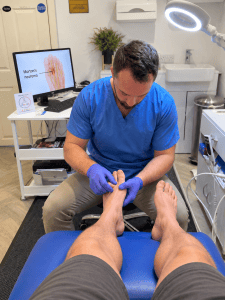
People often describe Morton’s neuroma differently. Common symptoms include:
- Burning pain in the ball of the foot
- Sharp or shooting pain towards the toes
- Tingling or pins and needles
- Numbness affecting the toes
- Feeling as though there is a pebble or small stone underneath the foot
- Pain when wearing tight or narrow shoes
- Symptoms that worsen during prolonged walking, running or sport
There may be no visible swelling or obvious change to the foot, despite significant discomfort.
What causes Morton’s neuroma?
Morton’s neuroma is thought to develop when a digital nerve in the forefoot is subjected to repeated irritation or compression.
Several factors can contribute, including:
 Footwear
Narrow or tight-fitting footwear can compress the forefoot and increase pressure around the nerve.
 High heels
Higher-heeled footwear transfers more pressure towards the front of the foot.
 Sport and activity
Running and activities involving repetitive loading of the forefoot may aggravate symptoms.
 Foot mechanics
The way your foot functions when standing, walking and running can influence how pressure is distributed across the forefoot.
Other conditions such as bunions and toe deformities can also alter loading across this area.
How is Morton’s neuroma diagnosed?
Diagnosis is usually based on your symptoms and clinical examination.
During a musculoskeletal podiatry assessment at Dunford Health, we may assess:
- The location and nature of your pain
- Tenderness around the metatarsals
- Sensation in the toes
- Foot and ankle movement
- Foot posture and biomechanics
- Walking or gait where appropriate
- Your current footwear
- Sporting and activity demands
Clinical tests may also be performed to reproduce your symptoms.
Sometimes other conditions can produce similar symptoms, including metatarsalgia, plantar plate problems, stress injuries and joint pathology.
Where appropriate, further investigation such as diagnostic ultrasound or other imaging may be recommended.
Morton’s Neuroma Treatment
Treatment depends upon your symptoms, activity levels and the findings from your assessment.
Footwear changes
One of the first steps is often reducing compression across the forefoot.
A shoe with a wider and deeper toe box may provide more space for the foot and reduce irritation around the nerve.
Insoles and orthotics
Insoles or customised foot orthoses may be recommended to help alter pressure underneath the forefoot.
A metatarsal dome or pad can sometimes be incorporated to help redistribute load away from the painful area.
Activity modification
You may not necessarily need to stop exercising completely.
Temporarily modifying activities that repeatedly aggravate the condition can help settle symptoms while the underlying contributing factors are addressed.
 Further treatment
If conservative treatment does not provide sufficient improvement, further options may be considered.
Depending upon the individual, this can include referral for image-guided injection therapy or specialist foot and ankle assessment.
Surgery is generally reserved for persistent cases that have not responded adequately to appropriate conservative treatment.
Can I still exercise with Morton’s neuroma?
In many cases, yes.
The important factor is how much the activity aggravates your symptoms.
For someone who wants to continue running or playing sport, our aim is to understand the factors contributing to the problem and develop a plan that allows you to remain as active as reasonably possible.
This might involve modifying training, changing footwear, using an orthotic or introducing other strategies to reduce forefoot loading.
When should I see a podiatrist?
Consider arranging an assessment if you have:
✓ Persistent pain underneath the ball of your foot
✓ Burning or shooting pain into your toes
✓ Numbness or tingling
✓ The sensation of having a stone underneath your foot
✓ Pain that keeps returning
✓ Difficulty finding comfortable footwear
✓ Symptoms affecting walking, running or sport
Getting the correct diagnosis is important because not every pain underneath the forefoot is Morton’s neuroma.
Morton’s Neuroma Assessment in Whitchurch, Shropshire
If forefoot pain is stopping you from walking comfortably, exercising or enjoying your sport, we can help investigate what may be causing the problem.
At Dunford Health Podiatry, your assessment will focus on identifying the likely source of your symptoms and developing an individual management plan.
 Dunford Health Podiatry – Whitchurch, Shropshire
Book a podiatry or musculoskeletal assessment today.